
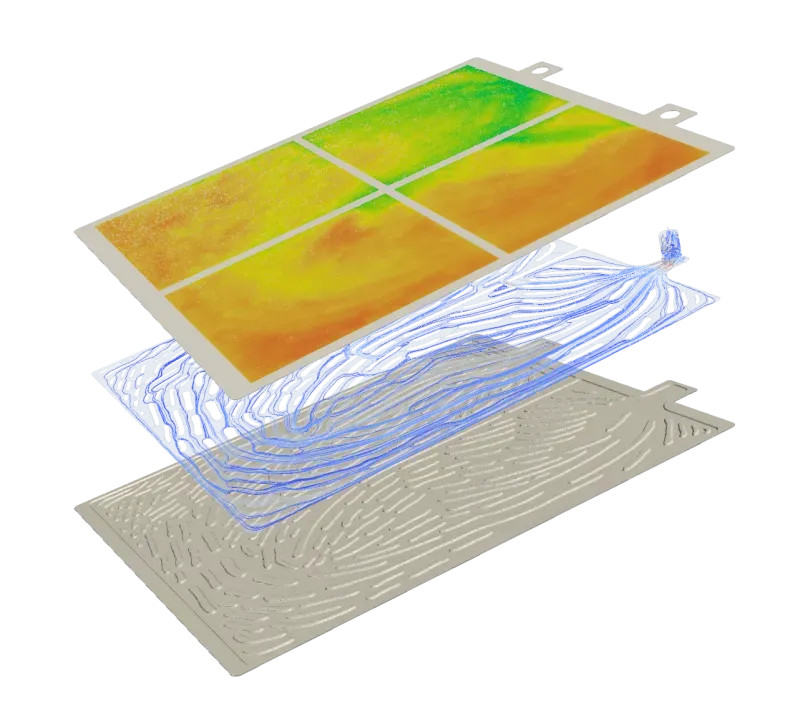
There is no doubt thermal design is entering a new phase. In 2026, performance targets are being set less by individual components and more by the lowest common denominator of system-level constraints including rack power density, package integration, coolant compatibility, materials availability, sustainability mandates and the practical reality of shipping on schedule.
Across market outlooks and technology roadmaps, one theme is consistent. Teams that treat thermal as an optimisation problem, rather than a late-stage verification step, will move faster and land stronger designs. That shift is also why generative thermal design is moving from an experimental capability into a pragmatic engineering lever.
With that in mind, below are seven evidence-backed areas to watch in 2026, and what key considerations we see to ensure they create an opportunity as opposed to an implication for your thermal design.
1) Liquid and hybrid cooling becomes the new baseline
The “default” cooling strategy for high-density compute is changing. Reports tracking data center thermal architectures increasingly position liquid cooling, notably direct-to-chip cold plates and immersion, as a primary growth vector as power densities climb beyond what air can handle efficiently.
What changes in 2026 is not simply adoption, but expectation: new projects will increasingly be scoped assuming liquid cooling is available, with air used as a secondary path or for specific subsystems. Hybrid schemes that combine approaches are being framed as core architectures over the next decade, particularly where energy efficiency and heat recovery targets are tightening.
Implication for thermal teams: The design space expands dramatically (flow distribution, manifold strategy, cold plate topology, materials, coolant properties, operating temperature windows), but iteration time becomes the bottleneck unless optimisation is embedded early.
2) Advanced semiconductor packaging pushes thermal “inside the package”
As packaging shifts from 2D to 2.5D and 3D integration, thermal is increasingly treated as part of package architecture rather than something solved by a downstream heat sink. Industry packaging discussions highlight that next-generation AI and HPC devices are forcing tighter coupling between power delivery, die stacking, TIM strategy, and heat extraction pathways.
This is reinforced by the broader silicon trajectory: process advances are still delivering efficiency gains, but overall compute density continues to increase, keeping thermal in the critical path of product viability.
Implication for thermal teams: You will see more projects where the correct answer is not “a better heat sink,” but “a different integration strategy,” including TIM1/TIM1.5 selection, heat spreading, and localised liquid approaches.
3) Thermal materials 2.0 and premium TIMs move from “nice to have” to strategic
High-performance TIMs and next-generation thermal materials are increasingly treated as performance multipliers, not commodity consumables. Market analyses point to rapid growth in advanced TIM categories and the value shift toward premium materials (liquid metals, advanced composites, and other higher-performance interfaces), especially in electronics and compute applications.
On the broader market level, thermal management technologies are projected to grow materially over the next five years, reflecting that material selection and integration are becoming core design decisions rather than procurement afterthoughts.
Implication for thermal teams: Material choices are increasingly coupled to geometry, assembly, reliability, and regulation. Expect more “multi-variable” optimisation where the best outcome depends on the combination of topology, TIM, coolant, and operating envelope.
4) AI-assisted thermal modelling and generative optimisation accelerate into mainstream workflows
Across thermal technology outlooks, software growth is being driven by AI-assisted modelling, digital twins, and simulation-based optimisation. The practical shift is from static, worst-case checks to optimisation-driven workflows that co-design geometry and constraints earlier in what was the conventional CFD process.
This is exactly the gap that generative thermal design software such as Coldstream addresses: rather than multiplying variants of a single concept, you explore a wider but relevant design space, then converge back to manufacturable, high-performing options.
Implication for thermal teams: The competitive advantage is not only higher performance, it is schedule protection. Teams that can “discover” the right thermal direction earlier reduce late changes, de-risk integration, and preserve downstream engineering bandwidth.
5) Data centers and AI infrastructure remain the dominant thermal innovation hubs
Thermal innovation is being pulled forward by AI infrastructure. Dedicated data center thermal research forecasts rapid expansion in liquid cooling ecosystems and highlights that cooling choices are now tightly linked to utilisation, energy consumption, and long-term operational constraints.
In parallel, the market narrative increasingly positions cooling architecture as a business-level decision because it directly impacts total cost of ownership and sustainability metrics.
Implication for thermal teams: Expect more board-level scrutiny of thermal trade-offs: not just “will it cool,” but “will it scale,” “will it be serviceable,” “will it comply,” and “will it support heat reuse strategies.”
6) Electrification and automotive electronics intensify multi-domain thermal design
Electrification continues to push thermal challenges beyond single-component cooling. Market coverage of automotive thermal management points to sustained growth driven by electrification and the increasing thermal complexity of batteries, power electronics, and compute-heavy ECUs.
This is a domain where thermal design routinely spans safety, packaging, reliability, cost, and manufacturability, with tight integration constraints and limited space. The practical outcome is more multi-domain thermal architectures (liquid loops, insulation strategies, interface engineering, and control logic) under aggressive timelines.
Implication for thermal teams: The winning workflow is repeatable: start from validated concepts, explore design options efficiently, and converge on manufacturable solutions early enough to avoid late-stage compromises.
7) Regulation, sustainability, and reliability become first-order design drivers
Thermal decisions are increasingly constrained by regulation and sustainability requirements. Chemical regulation developments, including ongoing activity around PFAS restrictions in Europe, are a reminder that coolant and material acceptability can change, and teams need design strategies that can adapt.
At the same time, data center regulation and heat reuse considerations are becoming more prominent in Europe, reinforcing that thermal systems are now part of broader sustainability and reporting frameworks.
Implication for thermal teams: “Best thermal performance” is no longer sufficient. The target is optimal performance within constraints that include manufacturability, supply chain resilience, compliance, and lifecycle considerations.
What does this really mean for thermal design teams in 2026
In reality: thermal engineering is becoming a discovery-and-optimisation problem under real-world constraints, and less of a late-stage ‘step-by-step, trial-and-error’ validation process.
That is why the most practical positioning for generative thermal design is not “more design variants,” but:
- Discovery: find better thermal directions earlier
- Optimisation: quantify trade-offs across geometry, materials, and operating conditions
- Viability: stay manufacturable and constraint-compliant
- Workflow fit: protect schedules by integrating into existing processes

.jpg)