Papers & Publications

CFD-Based Generative Optimisation of a Turbocharged Intake Plenum for Formula Student Applications

Diabatix, Matthew Harding

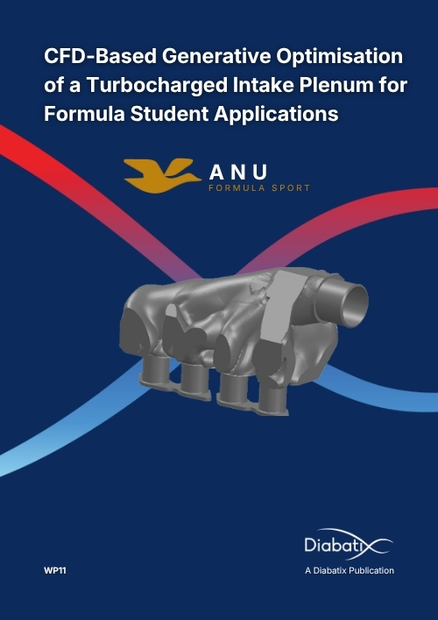
This white paper explores how CFD-based generative optimisation was applied to improve a turbocharged intake plenum for ANU Formula Sport’s Formula Student application. The study shows how ColdStream was used to move beyond traditional manual CFD iteration, targeting reduced intake energy dissipation and improved outlet flow distribution within real packaging and manufacturability constraints. The optimised plenum reduced intake energy loss from 15.28 W to 11.82 W, a 22.6% reduction, while improving flow imbalance from greater than 25% deviation to less than 2%. Physical validation confirmed the design’s manufacturability and functional feasibility.
Learnings

  • - How intake plenum geometry influences pressure loss, flow balance, volumetric efficiency, and cylinder-to-cylinder variation.
  • - How CFD-based generative optimisation can be used to improve complex internal flow passages within real engineering constraints.
  • - How ColdStream combines simulation, objective evaluation, and geometry updates in a closed-loop optimisation workflow.
  • - Why minimising energy dissipation and improving outlet mass-flow balance can directly support stronger intake performance.
  • - How generative CFD can complement traditional CFD by helping engineers identify better concepts faster, especially when time, compute resources, and manufacturing capacity are limited.
  • - How physical validation can confirm whether an optimised design is not only numerically improved, but also practical to manufacture and test.
  • ‍

    Download

    Leave your details and receive the white paper per email via a download link.

    Discover our other publications

    Get access to thermal designs you’ve never seen

    Book a demo